Almost every outdoor sauna conversation eventually arrives at the same fork in the road. Electric or wood. They produce broadly the same heat, but the experience of getting there couldn’t be more different — and one will suit your life much better than the other.
At iHKA we offer both. The Harvia Cilindro PC90 is our electric option; the Mini IKI is our wood-burning stove. Both are made in Finland by manufacturers that have been building sauna heaters for decades. Both will give you authentic Finnish löyly. The choice between them is not really about heat — it’s about what you want a sauna evening to feel like.
The honest difference, in one paragraph
An electric sauna is a fifteen-minute decision. You press a button on your way out the door, come back to a perfectly hot room, and step in. A wood-fired sauna is an hour-long ritual. You split the kindling, lay the fire, light it, and watch the smoke find the chimney. The room warms slowly, the stove ticks and crackles, and an hour later you’re sitting in a heat that has a slightly different character — softer, more enveloping, with the faintest tang of woodsmoke from outside. Neither is better. They are different practices.
The electric option: Harvia Cilindro PC90
The Cilindro is one of the most recognisable heaters in the modern sauna world — a tall stainless-steel column packed with stones, designed in Finland by Harvia. It runs at 9 kW at 240V, and it’s rated for sauna rooms between 141 and 494 cubic feet (roughly 4 to 14 cubic metres), which fits the iHKA cabin comfortably. It carries roughly 90 kg of stones — a lot of thermal mass, which is what gives it its soft, lasting steam.
The Cilindro’s defining feature is the open grate around the stones: you can throw water on the side of the column for a gentle löyly, or directly on top of the pillar for a sharp burst. That gives a bather the ability to fine-tune the steam without changing settings.
Choose electric if you want
- To sauna on weeknights without an hour of preparation
- Predictable, controllable temperature with a digital timer
- A maintenance routine that’s essentially "rearrange the stones once a year"
- No chimney, no firewood store, no smoke
What it asks of you
An electrician. The Cilindro is a hard-wired appliance and must be installed and connected by a qualified professional — this is not a DIY task. You’ll need a dedicated circuit, and the electrical work is part of your overall installation cost.
The wood-fired option: Mini IKI
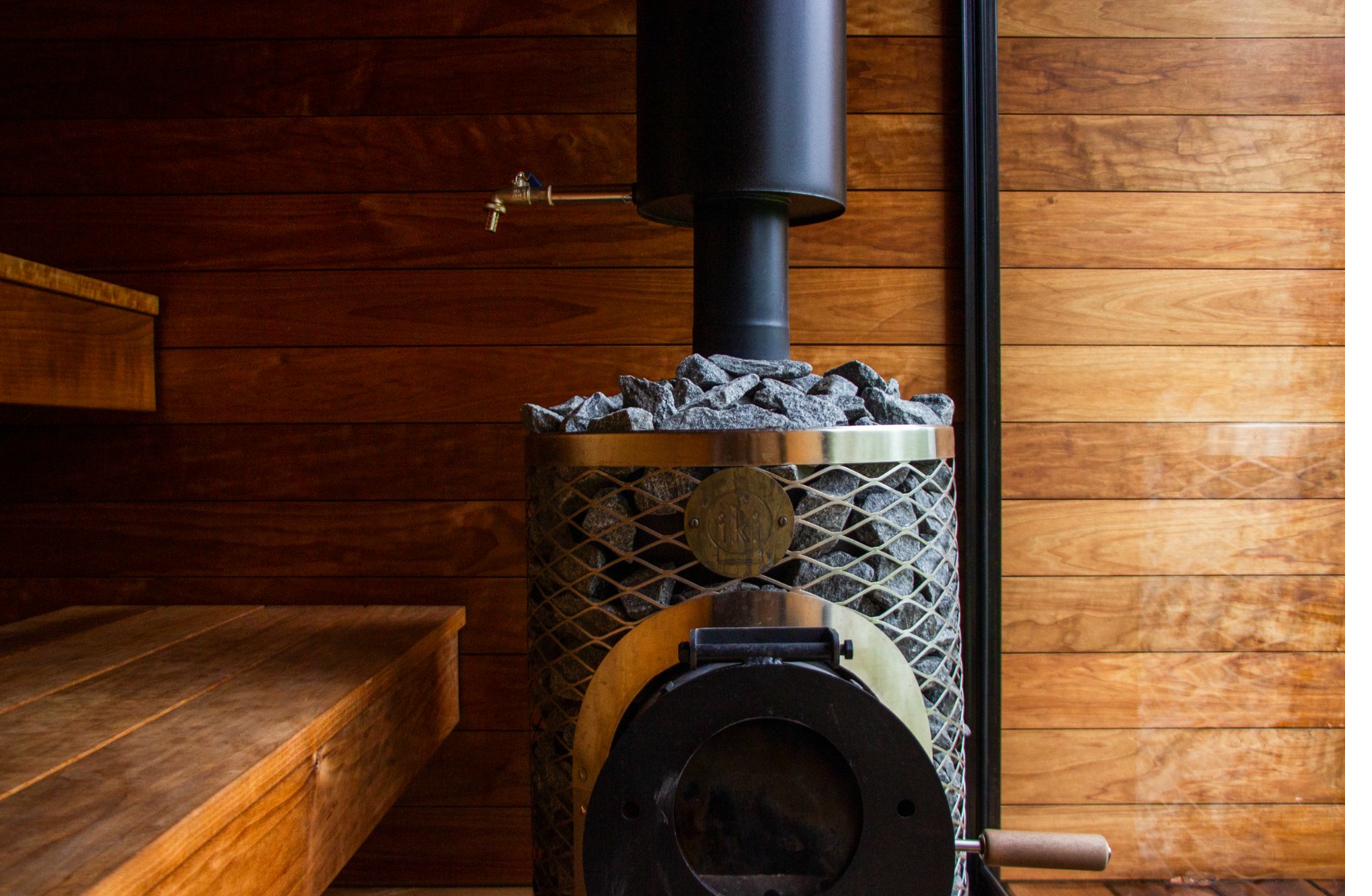
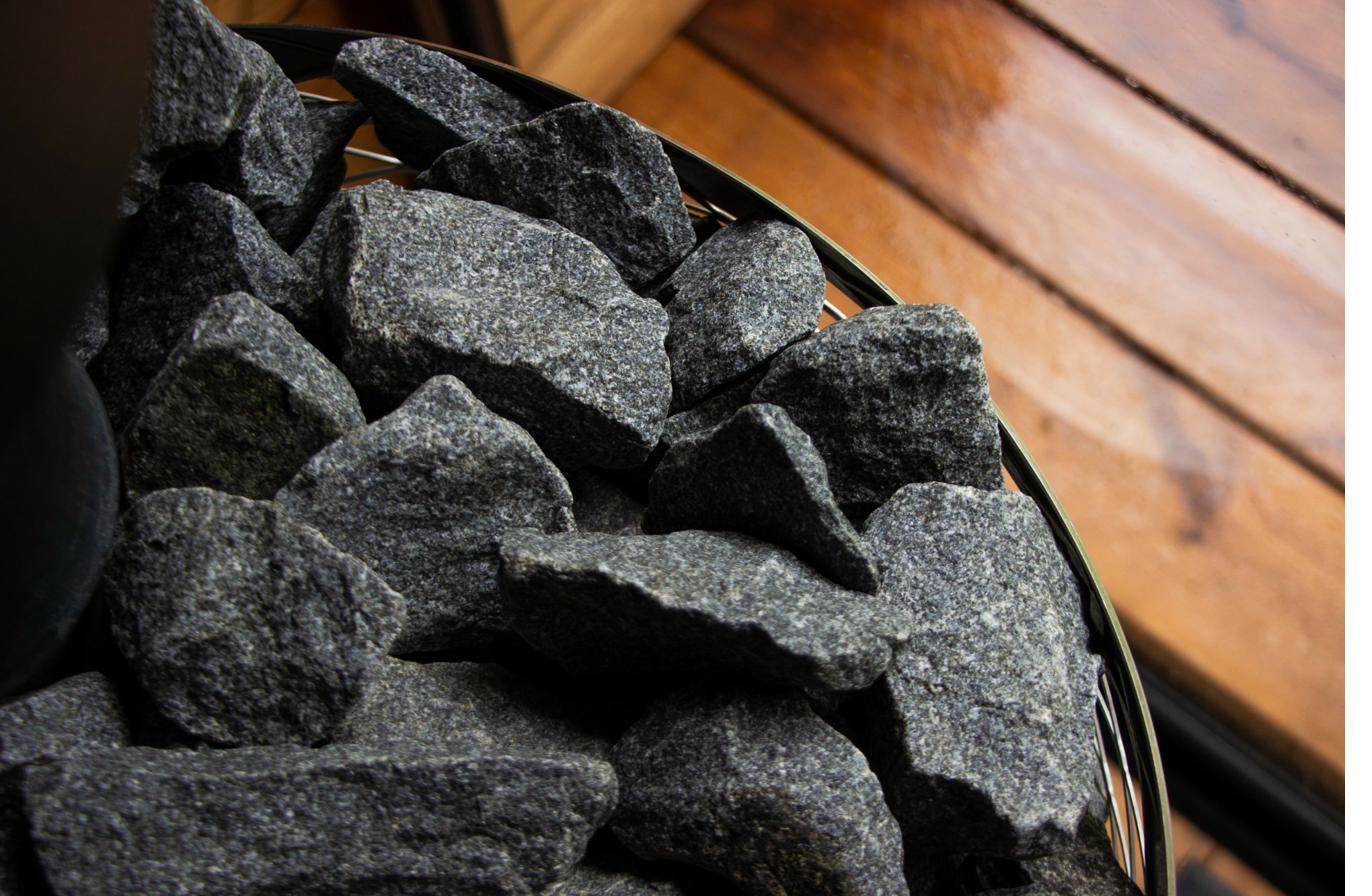
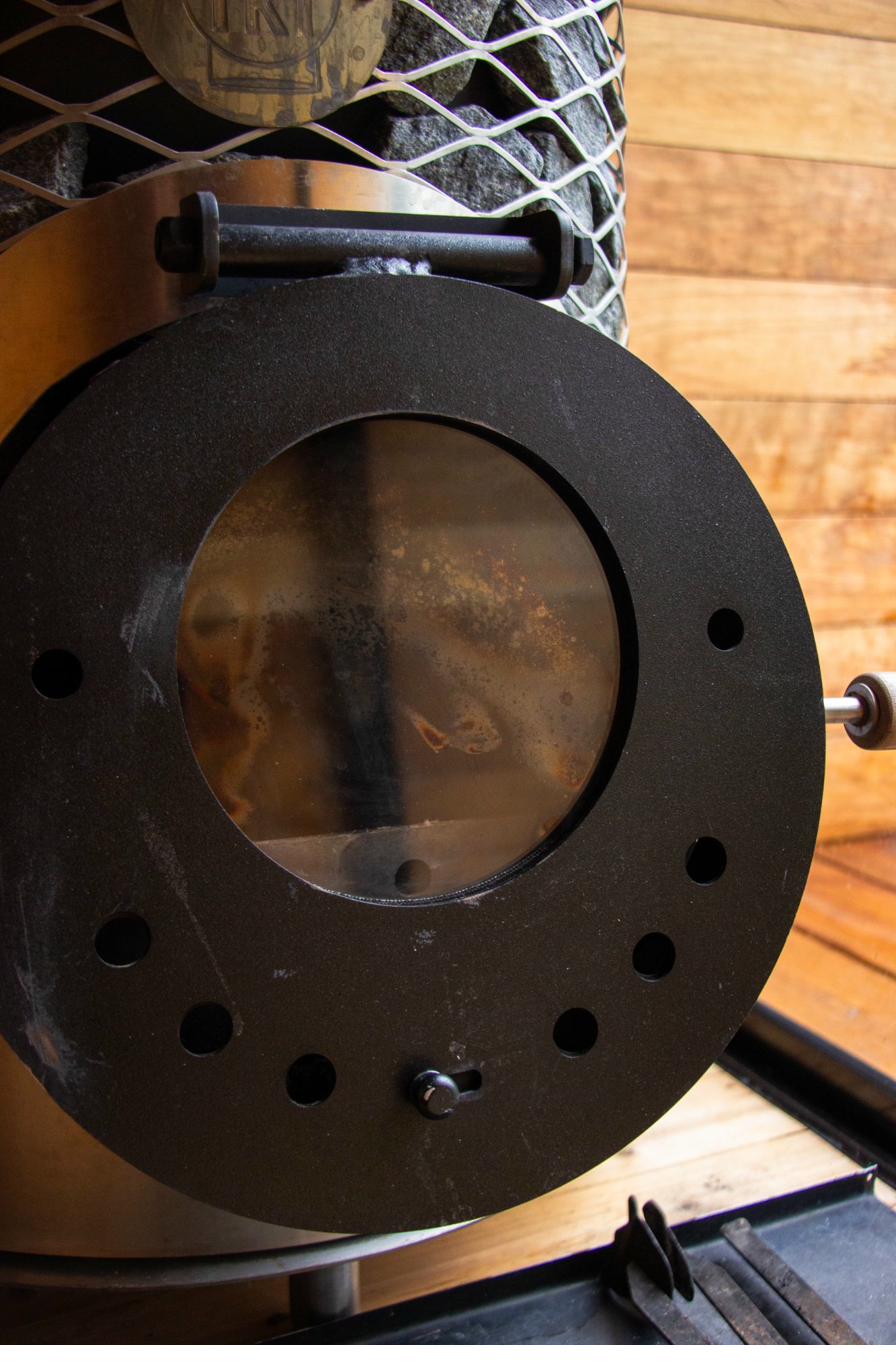
The Mini IKI is a wood-burning stove from IKI Kiuas, a Finnish manufacturer specialising in stone-heavy heaters. Its design philosophy is the opposite of minimalist: a generous mesh basket of stones surrounding a steel firebox, holding far more thermal mass than a typical wood stove. The result is an extraordinarily long-lasting, soft löyly once the sauna is fully warm.
What you sign up for, when you choose wood: the ritual. Splitting and stacking firewood. Laying a proper top-down fire. Watching the temperature climb over forty-five minutes to an hour. Adding a log when the room asks for one. And, in summer, the small joy of opening the door to a wood-warmed sauna in the garden.
Choose wood-fired if you want
- The ritual — the smell of woodsmoke, the slow warming, the crackle of the fire
- Independence from the electrical grid (useful for cabins, off-grid sites)
- The softest, longest-lasting löyly — connoisseurs almost universally favour wood
- A cabin that smells faintly, gently, of woodsmoke from the outside
What it asks of you
A few things. A chimney installation through the roof, sized and clearance-checked correctly. A nearby place to store dry, seasoned firewood. And ongoing chimney maintenance: per IKI’s guidance, sweep the chimney every three years for occasional holiday use, or annually for regular use. In Belgium, certified chimney sweeping is a regional requirement and is normally a condition of household insurance for any solid-fuel installation.
The two-minute decision tree
Imagine your most realistic sauna evening, six months from now. It’s Wednesday at 8pm, you’ve had a long day, and you want to be in steam in twenty minutes.
If that scenario sounds essential — if you know you’ll only sauna if it’s easy to start — choose electric. The Cilindro will be warm by the time you’ve poured a glass of water and changed.
If the slow build is part of the appeal — if you can already picture yourself laying a fire on a Saturday afternoon and not stepping in until evening — choose wood. The Mini IKI will reward you for the rest of your life.
Many of our owners genuinely struggle with this choice and ask the same question: "If you had to pick one, which would you choose?" Our honest answer is that we have both. They serve different moods. But if forced to one, our Belgian distributor goes wood-fired for the ritual, and our Finnish founder leans electric for the convenience. Reasonable people split right down the middle.
Can I switch later?
In principle, yes. Both heaters fit the same cabin, and a future swap is mechanically possible. In practice, the swap is non-trivial: it means new chimney work (in either direction), new electrical work or capping, and a recalibration of the heater clearances. We recommend committing to your choice up front. The good news is that both heaters last well into a second decade with proper care.